
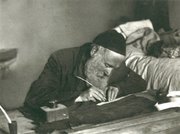





Showing posts with label Maharil Diskin. Show all posts

Tuesday, October 13, 2009

Doors on the Third Beis Hamikdash

Subscribe to the Daily Daf Yomi Summary here.

Rashi (several places in Shas) wonders how the Beis Hamikdash could be built on Shabbos (which Chazal say is a distinct possibility); isn’t that a desecration of Shabbos? Rashi answers that it is only regarding a Beis Hamikdash built by humans that there is a restriction of building it on Shabbos. The third Beis Hamikdash, however, will descend from Heaven miraculously, thus there are no restrictions regarding its building.

The Maharil Diskin is troubled by this answer, as the Jewish People have an obligation to build the Beis Hamikdash, so why would Hashem prevent us from performing this mitzvah?

He answers based on a Medrash in Eichah (2:9). It is written: "Tavu b'Aretz She-areha..." -- the gates of the Beis Hamikdash were hidden away, sunken into the ground, before the Beis Hamikdash itself was destroyed. When the Beis Hamikdash was destroyed, its gates sunk into the ground, and in the future, the Jewish People will excavate the gates and affix them to the Beis Hamikdash.

Our Gemora rules as follows: If a man builds a large mansion on the estate of a deceased convert (with no heirs) and another man comes and puts the doors on, the second person becomes owner. Why is this? It is because the first one merely arranged bricks there (for without the doors, there is no use for the mansion more that there already was with the land itself; it is the installation of the doors that completes the building).

Accordingly, we can say that we will fulfill the mitzvah of building the Beis Hamikdash when the Third Beis Hamikdash will descend from Heaven; it will be missing one thing. It will not have doors! The mitzvah will be fulfilled when we secure its gates.

This can also be the explanation of the words that we recite in the Shemoneh Esrei of Mussaf on the festivals: Show us its rebuilding (v’har-eynu b’vinyono) and gladden us with its perfection (v’samchenu b’tikuno). “Show us its rebuilding” refers to the sending down of the virtually completed third Beis Hamikdash. We will then complete the Beis Hamikdash by attaching the doors and will be gladdened by its perfection and by the fact that we fulfilled the mitzvah of building it.

Read more!

Thursday, May 07, 2009

Three Fellows Holding on

The Mishna had stated: Two people are holding on to a cloak. This one says that he found it, and the other says that he found it. This one says that it is all his, and the other claims that it is all his. This one should swear that he does not own less than half of the cloak, and the other should swear that he does not own less than half of the cloak, and they should then split the cloak.

If one says that the entire cloak is his, while the other one claims that only half of it is his, the first one should swear that he does own less than three quarters of the cloak, while the second one should swear that he does not own less than one quarter of the cloak. The first one then takes three quarters, while the second one takes one quarter.

They asked the Maharil Diskin when he was only a child: What would be the halachah if three people were holding onto the cloak? One of them said, “It is all mine,” and each of the other two said, “Half of it is mine.” We cannot say that the one who claimed that it is all his should receive half, and the other two should get a quarter each, for it would emerge that only the one who said that the entire cloak is his would be losing out because there is a third party in the case. Perhaps the halachah should be that we should give half to the one who claims that it is all his, for the other two are admitting that this half is his, and regarding the other half, it should be split in thirds between all of them, for they are all claiming on that half that it is completely theirs. This is also not correct, for the two that were claiming that half is theirs are not admitting that the other half belongs to the one person who claimed that it is all his, for although each one of them is admitting that it does not belong to them, perhaps it belongs in partnership to the other two?

He answered on the spot as follows: The one who claimed that the cloak is completely his receives half the cloak, plus a third of one of the remaining quarters. Each of the other two receives a third of one quarter and half of the remaining quarter. And he explained: Each one of the fellows who claimed that only half of the cloak is theirs is in essence admitting that the other half belongs to the other two – half to the one who said that it is completely his, and half to the other one who said that only half is his. It emerges that the fellow who said that it is completely his has an admission from each one of them that a quarter of the cloak is his. He therefore receives a quarter of the cloak. Each one of the fellows who are claiming that half the cloak is theirs is also admitting to the other fellow claiming a half that a quarter of the cloak is his. They each would be entitled to a quarter of the cloak except for the fact that the fellow claiming that the entire cloak is his is disputing their claim. Therefore, the two fellows claiming half the cloak is theirs each split a quarter with the one claiming that the entire cloak is his. On the last remaining quarter, all three of them are claiming that it is completely theirs. They therefore split that quarter in thirds.

Read more!

Thursday, June 21, 2007

MOSHE’S PROPHECY - Yevamos 49 - Daf Yomi

Gemora Bava Basra 14b states that Moshe wrote his sefer and the parsha of Bil'am? What is the connection?

"In the nation of Israel, there never arose another prophet of Moshe's stature" (Devarim 34:10) -- In the nation of Israel there did not arise, but among the other nations there did arise. Who was that? Bil'am!" (Sifri, end of Sefer Devarim, see also Bamidbar Raba 14:34)

How is it possible to suggest that Bil'am, the embodiment of evil character traits (Avot 5:19), prophesied on the same level as Moshe, the greatest of prophets? (Famous question - text from Parsha page Balak 5758)

Rabbi Mordechai Kornfeld cites the commentators who say that there is a basic distinction between the prophecy of Moshe and other nevi'im. Hashem spoke through the throat of Moshe - "mitoch g'rono shel Moshe." Maharil Diskin explains (end of teshuvos):

The Gemora (Yevamos 49b) tells us that all the prophets saw their visions through "a clouded glass," while Moshe's prophecy was through "a clear glass." In what way is a prophet's vision clouded? Is the Divine Word not clearly revealed to him? Rav Diskin explains as follows: When Hashem delivers a prophetic message to a prophet, it must first "materialize" into a worldly vision, one that is within the grasp of the prophet. The prophet must then apply himself to the task of understanding the meaning of the vision. Ultimately, the accuracy of his interpretation will depend on how closely he grasps the ways of the Creator, or how much he has subordinated himself to the Divine Will. The barrier of physicality that stands between the prophet and heaven "clouds" the prophet's vision.

Does that mean that sometimes a prophet can "miss the point?" If he can "misread" his vision, at times, how are we ever to know whether his prophecy can be relied upon? Rav Diskin answers that even if a prophet does not grasp all the fine points, and interprets part of it other than ideally, his interpretation will certainly come true. Once he is appointed to be a prophet of Hashem, he is entrusted with "prophetic license" to interpret the Divine communications that reach him as he sees fit, and Hashem will follow through based on the prophet's interpretation. The concept of a Divine message being subject to human explication is, after all, not a new one. With regard to meaningful dreams (which our Sages term "a minor prophecy," Berachot 57b), we are told that "Dreams are fulfilled according to the interpretation that one suggests for them." (Berachot 55b -- This concept in fact has parallels in the license afforded to Talmudic scholars to interpret the Written Law based on the 13 principles of the Oral Law).

Moshe, though, was different from all other prophets. He obtained the loftiest spiritual level that a man of flesh and blood can attain -- he totally subordinated his will to that of the Creator (Bamidbar 12:3). His grasp of the Divine Will was therefore total; his visions were through a "clear glass."

Hashem chose to grant the gift of prophecy to a gentile, and Bil'am was chosen for the position (Rashi 22:5). It was to be expected that he would prophesy through an "unclear glass," like most prophets. But this could have had grave consequences. Bil'am, with his terribly unrefined character (Avot 5:19), would certainly have "seen" in his vision a perverted view of Hashem's message. What would have happened had he interpreted it as a sign of calamity for Israel, instead of a sign of their redemption! Since prophecy is fulfilled according to the interpretation of the prophet, this could have had dire results!

In order to avoid this, Hashem changed the ordinary manner of prophecy in this one case. Bil'am was shown crystal-clear, pure visions -- he was treated to the unadulterated word of Hashem. ("What Hashem puts in my mouth, I shall speak" -- 22:38.) There was nothing for him to misinterpret and mis-foretell.

We can now answer our original question. The Sifri does not mean to propose the preposterous suggestion that Bil'am reached as lofty a level as Moshe. It means that there was one particular aspect of prophecy that no prophet shared with Moshe but Bil'am. That is, as far as clarity of prophecy is concerned, Bil'am's visions were as clear and unfiltered as Moshe's own visions.

Read more!

Sunday, April 15, 2007

Daf Yomi - Chagigah 8 - BLOWING EXTRA

The Shaagas Aryeh (103) rules: It is permitted for one to blow shofar for no apparent reason on Rosh Hashanah.

The Meishiv Davar (1:36) disagrees and states that there is a Rabbinic decree against blowing a shofar on Yom Tov; the positive commandment of blowing the shofar overrides the Rabbinic injunction. Once a person has fulfilled the mitzva, there is no reason to blow anymore and it would be prohibited for him to sound the shofar.

However, he proves from our Gemora, that as long as has not had a lapse in concentration regarding the mitzva and he still intends to perform the mitzva, he may do so.

Our Gemora states: One who designated ten animals for his shalmei chagigah, he is permitted to offer them all as korbanos and they override the prohibition against bringing vow offerings on Yom Tov. The Yerushalmi states that it is allowed even if he originally designated one animal and afterwards decided to bring another one; as long as his intention is for the shalmei chagigah, it is permitted.

Therefore, he concludes, that one may blow the shofar on Rosh Hashanah as many times as he wants, provided that his intention is for the fulfillment of the mitzva.

It is said over that the Maharil Diskin used to listen to thousands of shofar blasts on Rosh Hashanah; for he wanted to be certain that he had fulfilled the mitzva properly. He was extremely particular that the shofar blast should be of one continuous tone.

Read more!

Thursday, January 25, 2007

Daf Yomi - Taanis 17 - BEIS HAMIKDOSH BEFORE MASHIACH

The Gemora in Taanis 17a states that Rebbe maintains that it is appropriate for kohanim nowadays to abstain from drinking wine. This is because we anticipate the rebuilding of the Beis Hamikdosh at any moment and the kohanim will be needed to perform the service. However, since the kohanim cannot identify as to which mishmar they belong to and there will be a long line of kohanim by Eliyahu Hanavi discovering their mishmar, by that time the effect of the wine will dissipate and they will be able to perform the service.

The Minchas Chinuch (152:9) asks from the Gemora Eruvin (43a) which rules that if one makes a vow to become a nazir on the day that Mashiach ben David will arrive, he is permitted to drink wine on Shabbos and Yom Tov since Eliyahu does not come on Erev Shabbos. According to this, why doesn’t our Gemora mention that the kohanim are allowed to drink wine on Shabbos and Yom Tov?

He answers, based on a Yerushalmi that while it’s true that Eliyahu does not arrive on Erev Shabbos but the Beis Hamikdosh can be built on Shabbos even without Eliyahu arriving first.

Rashi wonders how the Beis Hamikdosh could be built on Shabbos; isn’t that a desecration of Shabbos? Rashi answers that it is only regarding a Beis Hamikdosh built by humans that there is a restriction of building it on Shabbos. The third Beis Hamikdosh, however, will descend from Heaven miraculously, thus there are no restrictions regarding the building of the third Beis Hamikdosh.

The Maharil Diskin is troubled by this answer, as the Jewish People have an obligation to build the Beis Hamikdosh, so why would Hashem prevent us from performing this mitzvah?

The Maharil Diskin answers based on a Medrash in Eicha that states that when the Beis Hamikdosh was destroyed, the gates of the Beis Hamikdosh sank into the ground and in the future, the Jewish People will excavate the gates and affix them to the Beis Hamikdosh. The Gemora in Bava Basra rules that one who secures the gates in an ownerless field is deemed to be the one who acquires the field. Thus, we will fulfill the mitzvah of building the Beis Hamikdosh when we secure the gates of the Beis Hamikdosh. This can also be the explanation of the words that we recite in the Shemoneh Esrei of Mussaf on the festivals, show us its rebuilding and gladden us in its perfection. The word for perfection is tikkuno, which can allude to the securing of the Beis Hamikdosh gates.

According to this, we can still question the permissibility of constructing on Shabbos if we will still be required to affix the doors to the walls, which is obviously forbidden to do on Shabbos. Shemuas Chaim, in his introduction to the Mikdash Dovid answers that korbanos can still be offered even without the doors of the Beis Hamikdosh.

Read more!

Thursday, August 24, 2006

Daf Yomi - Yoma 78 - Touching Food on Yom Kippur

There is a question discussed in some of the Poskim if one is allowed to touch food on Yom Kippur. Perhaps it has a halacha similar to muktza. Mahril Diskin brings a proof from our Gemora that it is permitted. Rav Yehuda stated that one is permitted to cool himself off with fruit and he actually did so with a certain type of vegetable. However, he retracts from this proof because the Gemora can be referring to fruits and vegetables that cannot be eaten raw and there is no suspicion that he will come to eat it, however a food that we are worried that one might forget and eat it, should not be touched on Tom Kippur.

Read more!