











Amalek’s name as an acronym for remembering Tamudic topics:
The Gemora sometimes offers acronyms, acrostics or other sorts of words or phrases as devices to remember subjects, rulings or the like having some common denominator. Our Gemora links the topics of a guarantor (arev), who may testify for a debtor; a lender (malveh), who may testify for a debtor; a purchaser (lokeach), who may testify for another purchaser from the same vendor; and a joint principal debtor (kablan), who – according to one opinion – may testify for a debtor (all depending on certain conditions) and connects them, rather controversially using the letters of AmaLeK as a mnemonic aid.
In his commentary on our sugya, Rabbi Yaakov Emdin wonders how the Gemora could thus use Amalek, whose memory we are commanded to erase (Devarim 25:19), and asserts that we may use the name to memorize Torah, “extracting the spark of holiness in him.” Indeed, he contends, the verse hints we may do so: “…Erase the memory of Amalek from under the sky; do not forget!” (ibid). The verse seems to indicate we may use Amalek’s name to prevent forgetting the details of Torah. The Gemora in Gittin 57b also alludes to Amalek’s spark of holiness: Haman descended from Agag, king of Amalek (Esther 3:1; Shemuel I, 15:8) but “Haman’s grandchildren learned Torah in Benei Berak” (see the expanded version of Rabbi Y. Emdin’s commentary in the Wagschal edition of the Gemora).
Apropos Haman, Beis Yosef (O.C. 690) cites Rabbi Aharon of Luneil, author of Orchos Chayim, that the children’s custom to scrawl Haman’s name on stones and knock them together while hearing the Megillah comes from a midrash on the verse “…I shall erase the memory of Amalek” (Shemos 17:14): “Even,” stresses the Midrash, “off the trees and stones.” Hence, he concludes, we must not ridicule the custom.
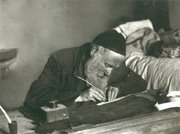
Erasing Amalek while testing pen: Kav Hayashar (Ch. 99) recounts that HaGaon Rav Heshel of Krakow would test his quill by writing Amalek or Haman and striking the name out as a reminder of the commandment to erase his memory.
The Gemora sometimes offers acronyms, acrostics or other sorts of words or phrases as devices to remember subjects, rulings or the like having some common denominator. Our Gemora links the topics of a guarantor (arev), who may testify for a debtor; a lender (malveh), who may testify for a debtor; a purchaser (lokeach), who may testify for another purchaser from the same vendor; and a joint principal debtor (kablan), who – according to one opinion – may testify for a debtor (all depending on certain conditions) and connects them, rather controversially using the letters of AmaLeK as a mnemonic aid.
In his commentary on our sugya, Rabbi Yaakov Emdin wonders how the Gemora could thus use Amalek, whose memory we are commanded to erase (Devarim 25:19), and asserts that we may use the name to memorize Torah, “extracting the spark of holiness in him.” Indeed, he contends, the verse hints we may do so: “…Erase the memory of Amalek from under the sky; do not forget!” (ibid). The verse seems to indicate we may use Amalek’s name to prevent forgetting the details of Torah. The Gemora in Gittin 57b also alludes to Amalek’s spark of holiness: Haman descended from Agag, king of Amalek (Esther 3:1; Shemuel I, 15:8) but “Haman’s grandchildren learned Torah in Benei Berak” (see the expanded version of Rabbi Y. Emdin’s commentary in the Wagschal edition of the Gemora).
Apropos Haman, Beis Yosef (O.C. 690) cites Rabbi Aharon of Luneil, author of Orchos Chayim, that the children’s custom to scrawl Haman’s name on stones and knock them together while hearing the Megillah comes from a midrash on the verse “…I shall erase the memory of Amalek” (Shemos 17:14): “Even,” stresses the Midrash, “off the trees and stones.” Hence, he concludes, we must not ridicule the custom.
Erasing Amalek while testing pen: Kav Hayashar (Ch. 99) recounts that HaGaon Rav Heshel of Krakow would test his quill by writing Amalek or Haman and striking the name out as a reminder of the commandment to erase his memory.
 Read more!